Translate

Friday, 25 September 2020

Capitals of Countries Series: Asian Edition

2. Jakarta, Indonesia


Capital: Jakarta

Country: Indonesia

Indonesia is a Southeast Asian country. Indonesia is the world's largest island country constituting seventeen thousand islands. It has 34 provinces, of which five have special statuses. The country's capital, Jakarta, is the second-most populous urban area in the world. Indonesia has vast areas of wilderness that support one of the world's highest level of bio-diversity. Indonesia is known for its natural beauty of volcanic mountains and oceanic beaches.

About Jakarta:

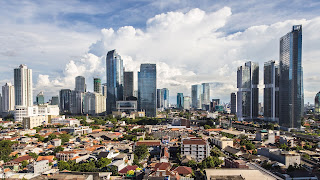
Jakarta is the capital of Indonesia and located in the Java province. After Tokyo, Jakarta is the second most populated urban habitation. The name Jakarta is derived from the Devanagari word, Jayakruth, with the meaning ‘Complete Victory’. Jakarta is officially a province with special capital region status. Its provincial government consists of five administrative cities and one administrative regency. Jakarta is nicknamed as the "Big Durian", since Durian fruit is native to the region.

Jakarta became the capital in the year 1950. The city was thriving with political and economic support as it was chosen to host the 1962 Asian Games. However, a coup was attempted in 1965 which led to the death of six top rank Generals followed by an anti-communist purge which resulted in the death of 5,00,000 people including immigrants.

The following decade saw a boom in Jakarta’s growth as slum dwellers were moved to better housed and various projects were laid out for infrastructural development. Most of this was achieved through foreign investments. But the Asian Financial crisis of 1977 arrested this growth. Following this, the next decade saw rise in tension ultimately ending in violent riots and destruction of infrastructure. In August 2007, Jakarta held its first-ever election to choose a governor as part of a nationwide decentralisation program with the help of local elections, unlike the previous practice of being elected by the legislative body.  

Jakarta has grown at a fast pace in terms of economy and population. As any major city, Jakarta too is faced with congestion with population upto almost 36 million in 2020. The urban lifestyle has led to heavy traffic and air pollution. But the biggest worry of Jakarta is that the city is sinking in to the ocean with each passing day.

Jakarta sits on top of swamp land. Hence, it often faces flooding and drainage clogging during rainy season. But Jakarta is sinking about 5 to 10 centimeters (2.0 to 3.9 inches) each year, and up to 20 centimeters (7.9 inches) in the northern coastal regions. Most of the area next to the sea is flooded throughout the year.

Government has set a task of building a manmade dyke (a wall to control the level of water) with a pumping system and retention area to lower the inflow of seawater. Giant Sea Wall Jakarta, the name of this project, is expected to be completed in 2025. There are talks about moving the capital from Jakarta to Kalimantan.

Jakarta is a melting pot in terms of ethnicity, religion and language. The city is home to Javenese, Sundanese, Chinese, Malays, and many more natives and migrants alike. Indonesian being the regional ligua franca, English and Chinese are also widely used. As for religion, Jakarta, and Indonesia as a country, is mostly Islamic.

Transport in Jakarta is mostly done through private vehicle or privately owned public buses. They have an Odd-Even policy in place, where in, vehicle with either odd or even number plate could only run on a given day. This is in order to curb traffic congestions and control air pollution.

Jakarta is another modernised city that people often frequent. It has beautiful beaches, big shopping malls and many museums to preserve its cultural heritage. So here is a list of places you can visit in Jakarta on your trip:

  • Istana Merdeka
  • Thousand Islands

  • Ragunan Zoo
  • Taman Mini Indonesian Park
  • Indonesian National Gallery
  • Setu Babakan Batavian Cultural village
  • Istiqlal Mosque
  • National Monument of Indonesia
  • Senayan City Shopping Mall
  • Sea World Anchol


Taman Mini Indonesia

Shopping Mall


National Museum

Sea World Anchol


Friday, 11 September 2020

Capitals of Countries Series: Asian Edition

 1. Tokyo, Japan

Capital: Tokyo

Country: Japan

Japan is an East Asian island country. The Japanese archipelago comprise of 6,852 islands with Tokyo as its capital. It is the 11th most populous country. The Greater Tokyo Metropolis is the world’s most densely populated metropolitan. This region has 37.4 million habitants. Japan is renown for its science and art. It has significant roots in automotive and electronic sectors throughout the world with leading companies like Toyota, Mitsubishi, Sony, Samsung and Nissan to name a few. In the field of art, animation and manga are amongst the leading trends.


About Tokyo:

Tokyo Metropolis is the capital of Japan. But this metropolis was once just a fishing village known as Edo. Looking back to history, in 1600, the great commander Tokugawa Ieyasu won the Battle of Sekigahara which secured Edo’s status as the most important place in Japan. In 1657, a great fire ignited burning down 70% of the city as the structures were made of wood and paper. Over 100,000 residents lost their life.

However, this didn’t stop the growth in population and by mid-19th century, Edo became home to millions. Japan had military Shogunate system for governance for 700 years, which was abolished during this period. A new government was formed and the capital of japan was renamed as Tokyo. During this time, Japan also opened doors to foreign trade.

During WWII, Tokyo was massively bombarded by USA between 1942 till 1945 which lead to loss of life in millions and many more lost their homes. It took almost a decade for Japan to get back on its feet on economical grounds.

Today, Tokyo has advanced technological resources, including robots to help tourists and in the field of customer services. Tokyo has higher concentration of retired individuals, than young working population. Hence, the government is working on reliance on technology to bridge the human resource requirement.

Tokyo heavily relies on subways and trains for transportation. Taxis are available but are rather expensive and cable cars are available for traveling within a locality. People also prefer to walk or opt for a cycle as train travel could be dense with massive over-crowding during peak hours. They even have a ‘Oshiya’ or pusher, who are typically train staff, who push passengers onto the trains.

Japanese Bullet Trains (Shinkansen) are prominently known across the globe for its speed. Traveling at maximum speeds of 240–320 km/h (150–200 mph), these bullet trains connect far away cities to Tokyo for commercial growth.

The city of Tokyo has many Michelin star restaurants that are especially famous for their Sushi and are extremely expensive. Fish has been a prominent part of Japanese cuisine since ancient and when American President Barak Obama visited Tokyo, he too had Sushi. As for fast food culture, the metropolis has around 300 Starbucks stores which overtakes London with 260 stores. They also have a massive range of vending machines that dispense everything from food to umbrella. They also have a vending machine for puppies.

Tokyo is a beach city located on the central pacific coast. Hence, its boundaries are shared with many islands. The city is also prone to massive earthquakes and volcanic activities. The buildings constructed are smaller than most skyscrapers found it other prominent cities as these structures are more cautious to seismic anomalies. They have also invented the Capsule Hotels. This facility includes a bed and internet connection, yet it costs around $30 to $50 per night. Mostly these hotels accept only male tenants for safety reasons.

Tokyo hosted the 1964 Summer Olympics, thus becoming the first Asian city to host the Summer Games. Tokyo was also supposed to host Olympics 2020 between 24 July and 9 August 2020, however, it is postponed to July-August, 2021 amidst Covid-19 pandemic. Tokyo will still continue to be the host due to commercial purposes.

To end this piece, here’s a list of places to visit in Tokyo if you are in town.

·        The Imperial Palace

·        Mount Fuji

·        Chidoriga-fuchi Cherry Blossoms

·        Senso-ji Temple (Asakusa)

·        Meiji Shrine

·        Parasite museum

·        Edo Wonderland (Samurai & Ninja Theme Park)

·        Tokyo Skytree

·        Disneyland Tokyo

·        Ueno Park & Zoo


Photo Gallery:

Cherry Blossoms

Robot at a Bank

US President Barak Obama at a Sushi restaurant


Capsule Hotel                                                                 Oshiya pushing passengers


Bullet Train
Lobster Vending Machine


Parasite Museum

Senso-Ji Temple


P.S. All images are taken from the internet and hence belong to their rightful owners. Thank you!


Monday, 7 October 2019

Aarey: The War for Trees

A lush greenery lies quietly in the lap of the never-sleeping Mumbai, in particular, the Aarey Colony. The area, which was once the heart of ghost stories for midnight office returners who travelled to Andheri/Goregaon/Malad, is now being robbed of its glistening green forest for building a Metro car shed. The protest against this project started in August after the Tree Authority sanctioned the cutting down of 2646 trees for the same. However, environmentalists and citizens of Mumbai joined hands in filing a petition in the Bombay High Court. The petition was dismissed and the decision was made in favor of the Government, leading to the start of the tree-felling process since Friday night. 

A Tale of a Tree
The rise in global warming has set all alarms at buzz, with intellectuals discussing and debating on how to slow down or even stop the rapid rise of carbon footprints and greenhouse gases, which are causing rapid change in the atmosphere, leading to abnormalities in weather patterns. While the hasty industrialisation is to be partly blamed, as the race to become the supreme power between the countries never ceases, another factor that has led to the suffering of humans and animals alike is DEFORESTATION. Here starts the story of how a rotten seed sown killed the healthy trees too.

A Seed was Sown
The master of the mansion was presented with a beautiful seed. The seller promised great fruits to ripen and flourish from this seed, to add colours to the already charming and vivid garden. The master didn't hesitate to accept this seed. With eyes filled with hope, he took it to the garden, unsure if there was a future where he would witness the seed bear fruit.

MMRC (Mumbai Metro Rail Corporation) first presented the idea of Metro Line 3 in 2011. The plan underwent further changes as new stations were added from the original, covering a total of 33.5 km between Colaba to SEEPZ. The estimated cost to build the whole project, including the 27 stations and the elevated and underground stations covering a total of 146 km of track, was Rs. 21,000 Cr.

The Central Government gave approval for the said plan in February 2012. Soon, the Union and the State passed the plan in June 2013 and February 2014, respectively. Chief Minister Prithviraj Chavan laid the foundation stone in August 2014. In 2015, a metro depot was recommended to be built on 30 hectares of land in Aarey Colony for the metro cars to rest during non-working hours and for carrying out repair and maintenance work. It is expected to house 55 trains and 8 coaches.

Providing Proper Soil and Nourishment
A seed cannot grow if it is sown in infertile land due to a lack of nourishment. A seed that falls on the rock will either be eaten away by birds or will dry away in the heat of the sun. A seed that is sown on the road will get trodden on. The master must carefully choose the soil that suits the seed and provide it with a timely supply of water and fertiliser.

Line 3 was previously planned to be funded through Public-Private Partnership (PPP). However, the idea was scrapped by Urban Development Ministry in August 2012. Instead, it proposed an 80:20 funding by the State and Central Governments. A special JV was formed between the two governments for the implementation of the project.

For the project to be implemented, a belt constituting both residents and plantation needs to be either cleared or relocated. Almost 2,800 families were relocated to Kurla and Chakala. While residents of building that were in danger of collapsing during the underground work were provided accommodation in South Mumbai with MMRC bearing all the expenses relating to their re-accommodation.

Surviving Harsh Climate
When a sapling sprouts, it has to undergo unavoidable changes in both its own form and the surroundings. The sapling with a frail trunk and few leaves must support its roots to grow further deep into the soil till it finds groundwater source. For this, the sapling has to withstand scorching summers, harsh winters and heavy rains. Only if it goes through the trials of seasons and succeeds to survive will it be able to follow its dream to one day flourish and bear fruit.

The construction of Line 3 faced multiple hindrances, with activists taking to court for preservation of the plants and forest life. The estimated plant life to be affected by this project is around 5,012, of which some will be cut down, while a majority will be replanted in other parts of this city. The agreement states that for one tree that's been cut down, three trees should be planted by the contract holder. However, 2 PILs were filed in the Bombay High Court to stop the cutting down of the trees as proper approvals were not received for the construction of the stations located in certain areas in February 2017. HC ruled in the contractor's favour, and the ruling was challenged in the Supreme Court. SC granted a temporary stay till May 2018.

Also, the selection of Aarey colony for the metro depot raised much opposition as almost 2,700 trees are to be cut down. The wildlife preserved by these trees may include leopards and other endangered flora and fauna. An open plot in Kanjurmarg was among the alternatives recommended. However, the idea was scrapped as a small portion of this plot was under dispute. There are also allegations that the rush to build a car shed in Aarey colony is also to invite further developmental projects, including residential buildings that will be forged by encroaching into forest lands.

A Seed Bearing Poison Fruit
It only takes one wrong decision to turn a beautiful and bountiful garden into a dead forest. A seed of the poison tree spreads its roots to the water source in the ground and spews its poison. The groundwater source that had kept the other plants nourished and healthy was now going to be the cause of their ruin, brought down by false promises blinding the garden master's decision. As the tree grew and flourished with fruits as dark as the heart of a morbid soul, its poison was choking the smiles of its fellow flowers and slowly clipping the clapping hands of the trees that had stood tall and proud against nature's tantrums.  

In the petition hearing in September 2019, the state government said to the court that Aarey cannot be declared a forest just because of the greenery, instead Line 3 project is very much needed for curbing traffic and reducing travel time. On 04th October 2019, HC declared that Aarey was not a forest. Hence, the MMRCL authorities started to axe trees from Friday night. 

A crowd of over 300 protesters immediately gathered, and many were arrested for hindrance.  Section 144 with criminal charges was quickly implemented in order to control the growing number of protesters at daybreak. Many voiced their concerns and tried to reason with the police, who had laid barricades to stop anyone who was not a resident of Aarey from passing through. Protesters became witnesses to the gruesome murders of those age-old trees as each cut of the axe swiftly took away the breath of these shading trees. Over 2,100 trees have already been cut down since the approval.

A Ray of Hope
However, the garden fairies that colored the leaves with the changing of seasons and blossomed the flower buds came to rescue the garden from being swallowed by darkness and depravity. In a world where any sign of kindness and sincerity is met with hatred and malice, the few who are crowned with strong will and grace to face the sword are still crossing blades with those who are 100 times more powerful. 

To those who stood disheartened, Monday morning brought with it a news that came as a breath of fresh air. SC issued a stay order on felling of trees till October 21st after a special bench was formed for the hearing of a Suo Motu PIL filed by a group of Law students led by Rishav Ranjan. The letter highlighted various issues that Aarey colony and Mumbai as a city will have to face. Other than chopping down the green lungs, the letter also mentioned that the project will affect Mitthi river, which could lead to flooding of Mumbai city and also pollute the river. In order to show good faith, SC also ordered to release of the protesters on submission of personal bonds. Government authorities have agreed to stop felling trees as ordered by the court and have released the detained protesters.

Small Victories are Power Boosters in Big Battles
As the fairies fought the foot soldiers of darkness, who were pinned by curse to follow their master's orders, many were taken to captivity. For the power of the soldiers was far greater, and the hearts of the fairies were kind and their wings tender. Yet they fought, holding their ground, trusting in their allies to back them. This faith led to a magic spell that pushed back the enemies to the boundary and brought back the fairies taken captive. The fairies rejoiced as they welcomed back their fellow brethren. However, they were well aware that this spell would expire in its due time, and the battle of the good and the bad would continue as the day and night chase after each other unceasingly. 

To many, this small victory brings great joy; however, the war is far from ending. With Government officials standing sternly on building the car shed in Aarey Colony, the alternative options have been shrinking from a few to none due to varying legal and technical reasons. The next hearing is to be held on 21st October 2019 after the special bench has gone through the details of the PIL. 

This is all the fact and fiction you need to be aware of with regard to the continued protests by the environmentalists and residents of Mumbai. While it is not a fairy tale, yet people are joining hands and standing their ground at Aarey with the hope that they will be able to find a happy ending to this saga. I would urge you, the reader, to think of this 'Does Government have enough Oxygen tanks for all our children and grandchildren?' Because we do not want development at the cost of the health of our and our future generations.

#StopCuttingTrees #SaveOurGreenLungs
P.S. The images do not belong to this blogger. They belong to their rightful owner.

Wednesday, 24 July 2019

Chandrayaan II: Another Proud Moment by ISRO

On 22nd July 2019 at 14:43 IST, Chandrayaan II made a successful launch from Satish Dhawan Space Centre at Sriharikota in Nellore (Tamil Nadu, India). The spacecraft carrying a lunar orbiter, lander and rover was originally scheduled to lift off on 15th July 2019 at 14:51 IST. However, due to technical issues spotted with less than an hour to take off, the launch was called off. The main objective stated by ISRO for this mission is to discover lunar water.

What is Chandrayaan II?
Chandrayaan II is the successor of Chandrayaan I by ISRO (Indian Space Research Organisation). Chandrayaan I was launched in October 2008 for mapping the chemical characteristics and topography of the lunar surface. The orbiter stopped sending signals in August 2009 due to technical issues. Soon after, ISRO declared the mission to be over. 

Chandrayaan II was originally planned to be made through a joint venture between ISRO and Roscosmos (Russian Federal Space Agency). The agreement was signed by the two agencies on 12th November 2007. ISRO was in charge of executing the orbiter and rover, while Roscosmos was responsible for the lander. This mission got extended from a launch in 2013, as anticipated, to 2016, due to the failure of Roscosmos in delivering the lander. However, later Russia withdrew from the project as Fobos-Grunt mission to Mars failed. The same technology was being used in other space missions as well. 

In 2015, India decided to build Chandrayaan II on its own. The mission was set to motion with a launch date expected to be in March 2018. But the launch was further rescheduled to April, then October. In June 2018, the launch was further pushed to the first quarter of 2019 after the Comprehensive Fourth Technical Review Meeting. During a test carried out in February 2019, the lander’s leg sustained some minor damage. 

Later, on 15th July 2019, preparations for the launch were almost underway, but were aborted due to a technical glitch.  

Design of Chandrayaan II:
The launcher, GSLV Mk III (Geosynchronous Satellite Launch Vehicle Mark III), carries three components, namely, the orbiter, Vikram lander and Pragyan rover. 
The Orbiter-
The orbiter lift-off weight is approximately 2379 kg. It will orbit the moon at an altitude of 100 km. The high-resolution camera on the orbiter will capture images of the lunar surface before detaching from the lander and rover.  It carries eight devices, most of which are made by ISRO or Indian subsidiaries. The orbiter is expected to last 1 year in the lunar orbit. 
Vikram Lander-
The lander is named after Vikram Sarabhai, who is considered the father of the Indian space program. The estimated lift-off weight of the lander is 1471 Kg. The lander is expected to detach from the orbiter using its 800 N liquid main engines. Initially, the lander had four main liquid engines. However, another engine was mounted centrally in order to remove the lunar dust draft during landing. The lander will be conducting various scientific research on the lunar surface for 14 days after achieving a soft landing and deploying the rover.
Pragyan Rover-
The solar-run rover is named Pragyan, which means ‘wisdom’ in Sanskrit. It weighs around 27 Kg. The rover has six wheels and will commute at 1 cm per second on the surface. During its navigation on the surface, it will carry out chemical analysis, the data of which will be received by the Earth station through the lander. 

The stereoscopic 3D camera will provide 3D imaging of the surface, which will enable the ground control team to navigate the rover. The rover is expected to accomplish its mission within 14 Earth days, which equals 1 lunar day, as it is not equipped with the infrastructure to withstand the cold lunar night. 

Objective of Chandrayaan II:
The main objective of this space mission is to understand and study the lunar topography and exosphere. To find the chemical composition of the lunar soil and discover water bodies/content, which is better known as Lunar water. The orbiter will also help sketch a 3D map of the moon’s surface. 

Chandrayaan II Leading Scientists:
Muthaya Vanitha (Project Director)
Chandrakanta Kumar (Deputy Project Director)
Ritu Karidhal (Mission Director)
Nandini Harinath (Deputy Operations Director)
Anuradha T K (Programme Director at ISRO)
Project Cost of Chandrayaan II:
The total allocated cost of the Chandrayaan II project is Rs.978 crore, and the bifurcation is as follows
GSVL Mk II = Rs. 375 crore
Space Equipment = Rs. 603 crore
There is also a lot of buzz going on around how this space programme by ISRO costs less than certain Hollywood movies, such as Avengers: End Game and Dark Phoenix, among others. 

Chandrayaan will orbit the Earth till it attains enough thrust to set course for the moon. The expected date of landing is 07th September 2019 between two craters (Manzinus C and Simpelius N). India will become the fourth country to successfully land, preceded by Russia, US and China. The morale is high among all Indians on this grand feat of by ISRO as fingers are crossed for a soft and successful landing of Chandrayaan II on the moon.

Friday, 12 July 2019

Hauntings from Around the World


Aahat to Supernatural to The Wailing… I’ve watched them all. Yes readers, today’s feature is on ‘Hauntings’. It is a general understanding that horror as a genre is pure fiction. A writer’s imaginary ghost killing non-existent humans in a place that’s usually a house, mental institution or a remote cottage in the woods. However, the receptive audience might absorb the content as per their subjective beliefs.

Do I believe in ghost or to put it more descriptively, souls of dead people impended between death and afterlife only to be stuck on Earth? As if life wasn’t hell already (Laughing). My beliefs are of little importance but my reader’s beliefs matter. As that would decide whether you will show any interest on reading further or not. Here are some of the places that are tagged as haunted with the scariest backdrop.

Are you ready with Holy water and prayer of deliverance?

1. Bhangarh fort (Rajasthan, India)
Bhangarh fort tells the tale of a black magic practitioner who fell in love with the princess who lived in this fort. He tried to win her heart using black magic. The princess came to know of his dishonorable ways and got him killed. Before dying, he cursed the villagers to die and also said that the houses will stay roofless. It is said that if you build a roof in this village, it will end up collapsing.

2. Monte Cristo Homestead (New South Wales, Australia)
When you truly love someone, losing them would break you. Mrs. Crawley, who once owned this house, is said to have locked herself in the house for 23 years after her husband’s death. Later when she died, people say that they have seen her ghost wandering in the house and there are also incidents of strange voices and flickering lights inside the house.

3. Highgate Cemetery (North London, England)
If you think vampires are nice after watching Twilight, this might change your mind. Highgate cemetery, the resting place for over 1,50,000 people, is said to be haunted by a vampire. Rumour has it that the vampire is 7 feet tall and has the ability to freeze time and hypnotise with big red eyes. He is often spotted wearing a black long robe. This place caught the attention of people when a woman was found decapitated and burnt. Cold hearted!

4. Ancient Ram Inn (Gloucestershire, England)
Its high time we introduced sacrifices and cult stuff in to this conversation. Ancient Ram Inn was established in 1145. This inn is said to have a history of satanic sacrifices and is built on pagan burial ground. The customers of this inn have even jumped out of the windows at the sight of flying furniture and sounds of children screaming. Such facilities after paying 25-30 Euro, sucks!

5. Greyfriars Kirkyard (Edinburgh, Scotland)
A poltergeist, finally! Greyfriars Kirkyard is a cemetery haunted by Sir George Mackenzie’s ghost. All thanks to a homeless man who broke in the Mackenzie’s mausoleum. It is said that people are often physically attacked and left with bruises and scratch marks. Also, visitors have experienced black outs. Sir Mackenzie sounds like a bad boy.

6. Paris Catacombs (Paris, France)
We all have seen human bones or replicas of the same in our school science lab. But how many of us have seen hundreds of human bones kept artistically in a tunnel. Voila! You don’t need to fret much. In your next trip to Paris, a visit to this tunnel could be an add on. Visitors are not just bewildered by this jaw-dropping sight but there have been reports of people disappearing altogether. If you are lucky you’ll just see apparition. Yikes!

7. Island of Dolls (Mexico)
This one had featured in my ‘20 Strangest Islands on Map’ article (http://bsoccergirl92.blogspot.com/2018/12/top-20-strangest-islands-on-map.html). It is called as Isla De Las Mulecas, the literal translation being “Island of Dolls”. In 1950’s, the island keeper found a dead body floating in the water. It was a young girl. However, he could not save her. A few days later, a doll came floating in the water. He thought that it was the young girl’s doll and hung it up on a tree. The island keep felt that the girl was haunting the island, hence, he hung all the dolls that came floating in the water. There are thousands of grotesques dolls hung throughout the island.

8. Screaming Tunnel (Ontario, Canada)
A 100 years ago, a young girl died inside the tunnel when her house caught on fire. Her house was on the other end of the tunnel. She ran into the tunnel for help but died before she could find anyone. This tunnel now lies below the railway tracks connecting Toronto to New York. It is said that if you light a match or lighter inside the tunnel, you can hear the screams of a girl and the fire goes off on its own.

9. Aokigahara Forest (Mount Fuji, Japan)
This 30 square kilometers spread of forest is renown as “Suicide Forest” as it has the second highest rate of suicides in the world. It is said that the souls of the people who died in the forest, haunt the place. Though the forest looks majestic, it has its demons.

10. Changi Hospital and beach (Singapore)
War leaves scars on the soul. Changi Hospital was used by the Japanese soldiers to torture Chinese soldiers during World War II. Many Chinese soldiers were killed by the Japanese soldiers in at the Changi Beach and Hospital. Both locations are now said to be haunted by the spirit of the deceased soldiers. There have been sightings of headless soldiers walking on the beach.

11. The Langham Hotel (London, England)
If you feel that you could never meet a Royalty in real life, don’t be disappointed. This 153- year old hotel houses Royal spirits including Emperor Louis Napoleon III and a German Prince, who jumped to his death. This place came into news in 2014 when players of England National Cricket team ran out of the hotel due to sudden flickering of lights and other paranormal activities.

12. Hoia-Baciu Forest, (Transylvania, Romania)
Forests are supposed to be beautiful with lush greenery and wonderful creatures. But what is a UFO doing here? Yes. This forest has found its place on the haunted list, when a military technician photographed an UFO hovering over the forest in 1968. It is believed to be an other-world portal as many visitors have disappeared in the forest and for those of who have survived, they suffer from rashes and nausea. Some call it the Bermuda Triangle of Transylvania. If there are disappearances, then I agree!

13. Poveglia Island (Venice, Italy)
The last and the creepiest place is half a mile away from Venice, the Poveglia Island. This island also featured in my ‘20 Strangest Islands on Map’ article (http://bsoccergirl92.blogspot.com/2018/12/top-20-strangest-islands-on-map.html). Its history has a combination of worst death. Plague, armory and mental asylum- the magic portion for haunting created. This island was used by Napoleon for the storage of his arms and ammunitions, later as a quarantine in 1776 at the outbreak of bubonic plague, and as a mental asylum. The soil of the land has traces of human skeleton. It is cited that people can hear the bell of the bell tower ring, even though the bell was taken down decades ago. There is a ban on human visit on this island. 

So I’m ending the list on the ominous number and putting it out on a ominous date. If today was Friday, then the circle of superstition would have been complete. As for whether these places are in reality haunted or not is purely dependent on what you experience when you are at this place. But who so ever plans on visiting such places, I would ask you to carry your ghost repellent weapons and a brave heart. May the God have mercy on you soul!